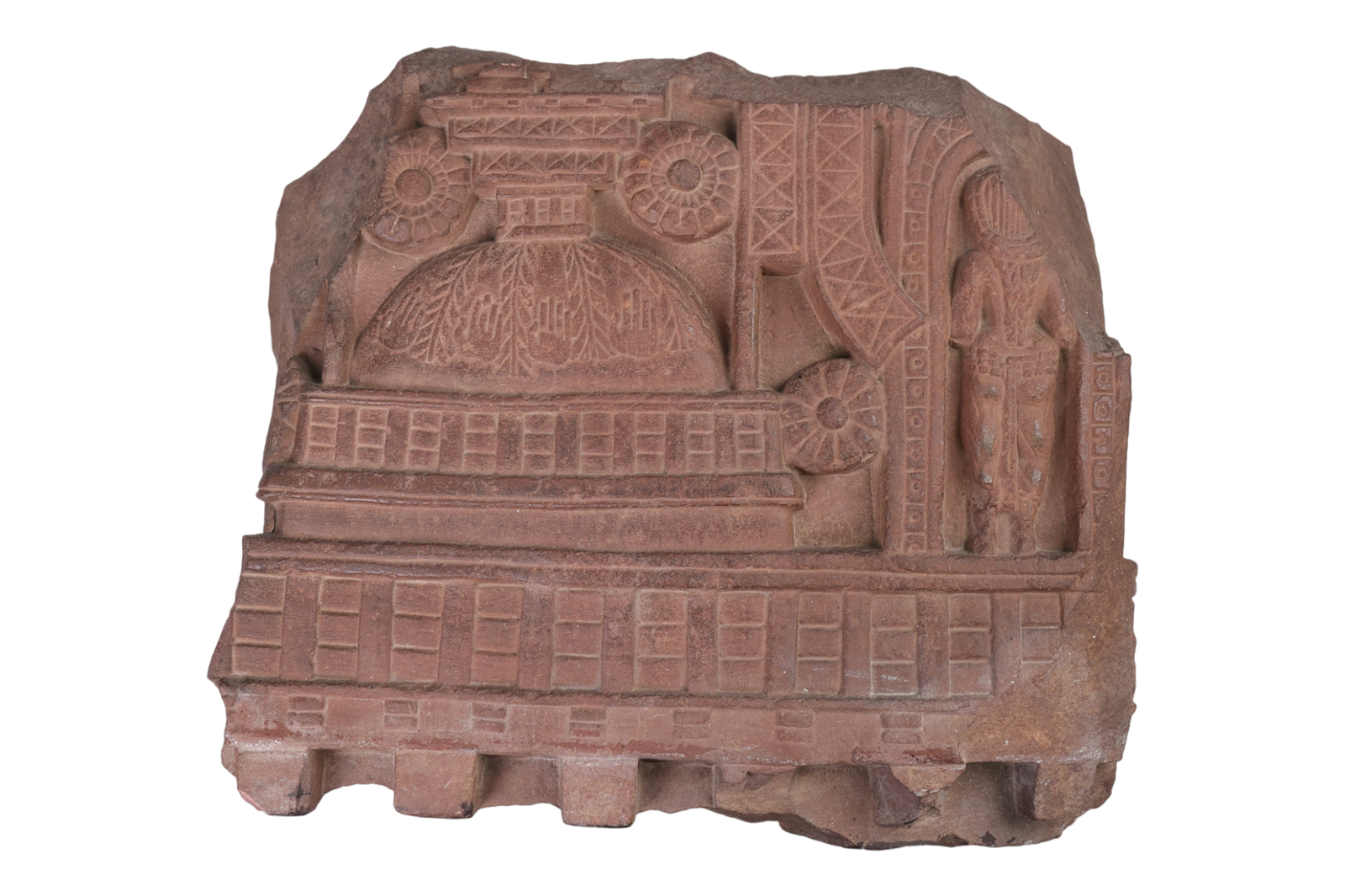
This relief fragment from Bharhut features a stupa enclosed by a railing, crafted from red sandstone. The adorned stupa occupies a substantial portion of the fragment, while about one-fourth of the space is dedicated to a female devotee entering the stupa’s enclosure to perform circumambulation (pradakshina). She approaches through one of the arched gateways set within the broad railing, which is crossbarred and crowned by a coping stone. The stupa consists of a mud core at its centre, topped by a harmika on its outer surface, symbolising the axis mundi. This fragment offers valuable insight into stupa architecture commonly found at Bharhut and Sanchi. An essential aspect of this depiction is the intricate decoration on the stupa; its hemispherical dome is adorned with auspicious handprint motifs, frequently seen at Bharhut. Floral streamers are draped from the two-tiered harmika, and two prominent lotus medallions grace either side of the stupa. The female devotee is depicted with a Shunga period braided hairstyle and a decorated coiffure. She wears a dhoti secured by a girdle (mekhala). Viewed from the back, her physical features evoke the Shunga yakshi prototypes, characterised by a prominent head, a slender waist, and a robust lower body. Her arms are visible up to the elbows, suggesting that her hands are folded in supplication as she circumambulates the stupa.