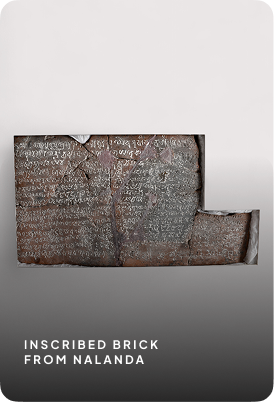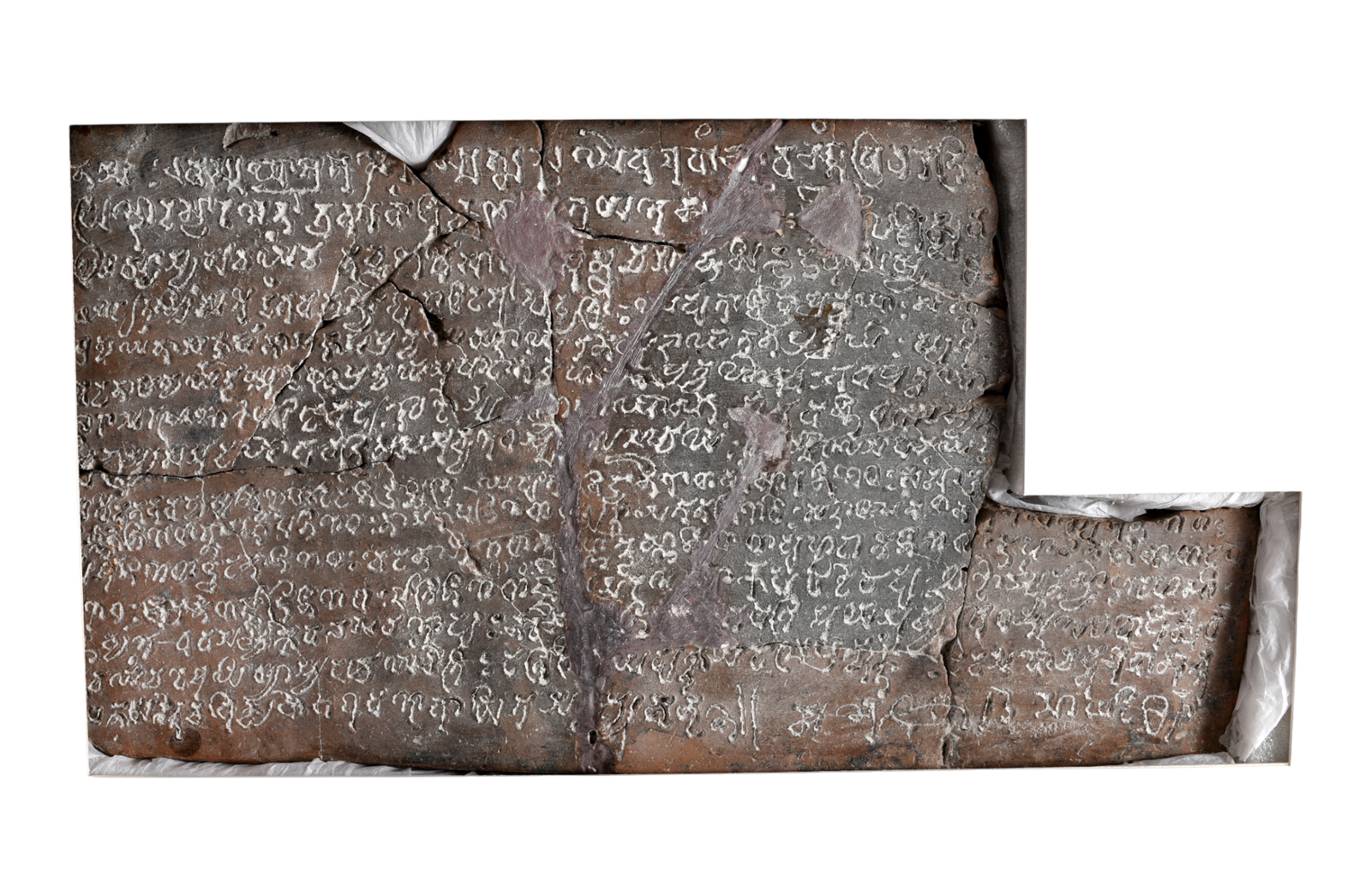
An inscribed brick from Nalanda gives the text of the Nidhana Sutra or the Pratitya Samutpada Sutra together with the Nirodha portion called the achaya and the apachaya of dharmna. It was found in 1936-37 from the core of a votive stupa attached to the main stupa of Nalanda originally found in pieces; it has now been pieced together and contains 15 lines of writing with the upper right portion lost. The characters were engraved with a stylus when the brick was wet and are in a cursive style. They belong to the Gupta script of a comparatively late period or the transition period to acute angled stage and may be ascribed to the 6th Cent. A. D. It is dated Magha 25 in the year 197 i.e. A.D. 516- 517 as the era used appears to the Gupta era. This is inscription helps in precisely dating at least one successive addition to the main stupa at Nalanda i.e. ascribing the fifth addition to the stupa to circa 5th Cent. A. D. The text on this brick is the same as found in the Kasia copper plate and the inscribed brick from Gopalpur in Gorakhpur U.P.
English Translation
1. Homage. Thus have I heard: at one time the Blessed One was dwelling at Śrāvastī, in the Jetavana, the park of Anāthapiṇḍada.
2. There the Blessed One addressed the monks and said: “O monks …”
3. “I shall teach you accumulation (āchaya, origination) and also decrease (apachaya, cessation). Listen to it well, attend to it carefully, and bear it in mind.
What is the accumulation of phenomena (dharmas)?”
4. “That is to say: when this exists, that comes to be; from the arising of this, that arises.
Namely: from ignorance as condition arise formations; from formations as condition arises consciousness.”
5. “From consciousness as condition arise name-and-form; from name-and-form as condition arise the six sense-bases; from the six sense-bases as condition arises contact; from contact as condition arises feeling.”
6. “From feeling as condition arises craving; from craving as condition arises clinging; from clinging as condition arises becoming; from becoming as condition arises birth.”
7. “From birth arise old age and death, sorrow, lamentation, suffering, mental distress, and anguish.
Thus arises this whole mass of great suffering.”
8. “This is called the accumulation (origination) of phenomena.
What, then, is the decrease (cessation) of phenomena?”
9. “That is to say: when this does not exist, that does not come to be; from the cessation of this, that ceases.
Namely: from the cessation of ignorance comes the cessation of formations; from the cessation of formations comes the cessation of consciousness.”
10. “From the cessation of consciousness comes the cessation of name-and-form;
from the cessation of name-and-form comes the cessation of the six sense-bases;
from the cessation of the six sense-bases comes the cessation of contact.”
11. “From the cessation of contact comes the cessation of feeling;
from the cessation of feeling comes the cessation of craving;
from the cessation of craving comes the cessation of clinging;
from the cessation of clinging comes the cessation of becoming.”
12. “From the cessation of becoming comes the cessation of birth;
from the cessation of birth come the cessation of old age and death, sorrow, lamentation, suffering, mental distress, and anguish.”
13. “Thus there is the cessation of this entire mass of great suffering.
This is called the decrease (cessation) of phenomena.”
14. “Therefore, O monks, when I said, ‘I shall teach you the accumulation and the decrease of phenomena,’ this is what was meant.”
15. Having said this, the Blessed One spoke thus. The monks, delighting in the words of the Blessed One, rejoiced.