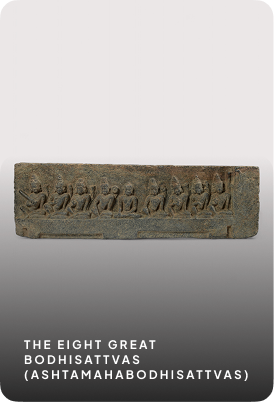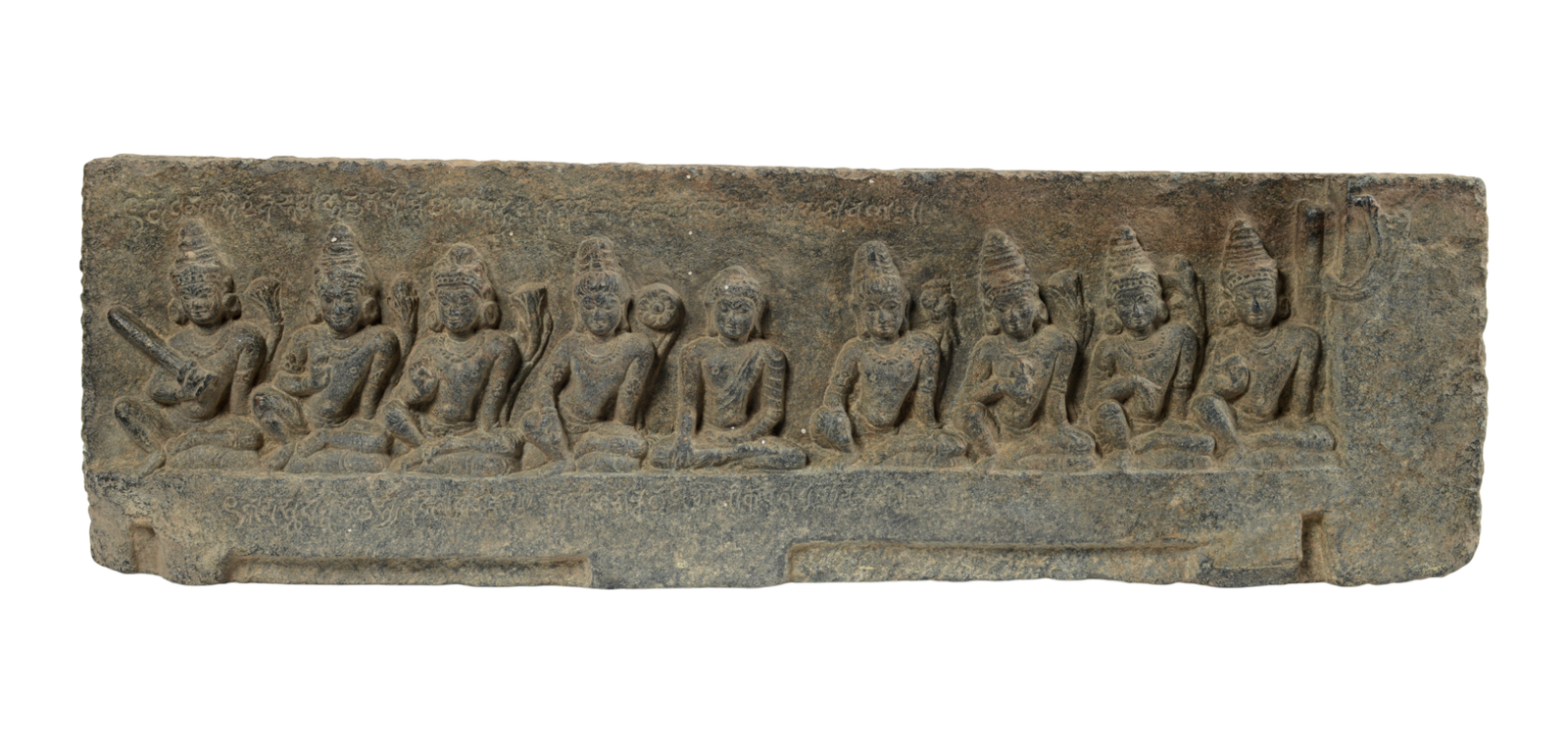
Theravada and Mahayana Buddhism emphasize Bodhisattvas, who serve as saviors by sacrificing their own salvation to help others. In this Pala period sculpture, all eight Bodhisattvas (ashtamahabodhisattva) appear similar in posture, wearing royal clothing and tall conical crowns. At the center, the Buddha sits in an earth-touching pose (bhumisparshamudra), with his robe covering one shoulder (ekansikasanghati). To his right are Avalokiteshvara, Manjushri, Maitreya, and Akashagarbha. To his left are Sarvanivaranavishkambin, Vajrapani, Samantabhadra, and Kshitigarbha. Each Bodhisattva uses different mudras, which help identify them.
There are two lines of inscription, the one at the top and the other at the bottom of the panel, which reads:
1) Top: ……(Ye dharma) hetuprabhavā hetuṃ teṣāṃ tathāgato hyavadat(sam) cayo
Niro evaṃ vādī mahāsrava aṇaḥ
2) Bottom: …. Kāyasthayajyva (jna) dattasya duhita herukā (ya) grhavāsi sha rikushali ka (a) rita pu yavṛdd (ye)
‘The Goddess of the householder is done (caused to be done) blissful by Herukā, the daughter of Yajñadatta, a Kayastha (scribe).’