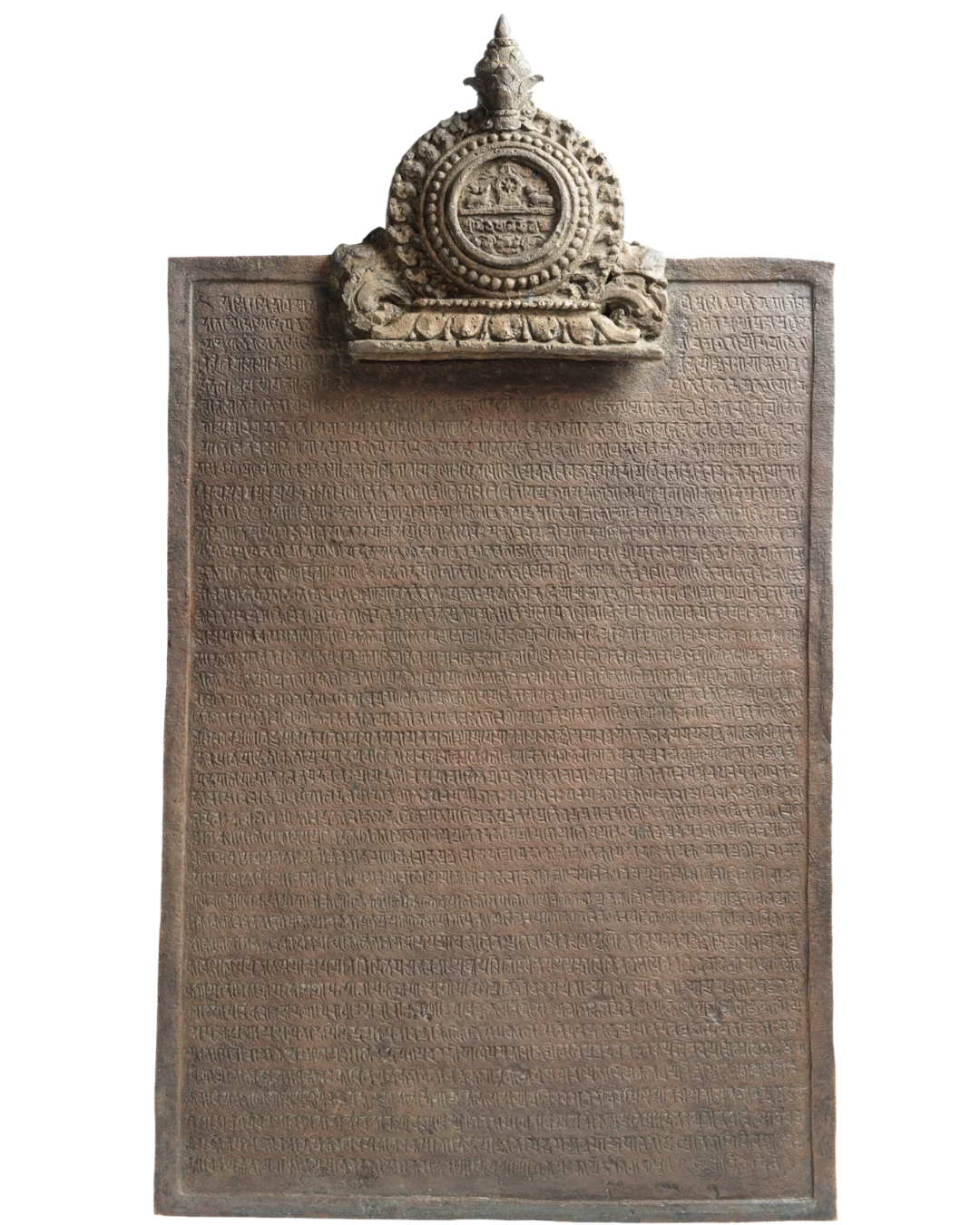
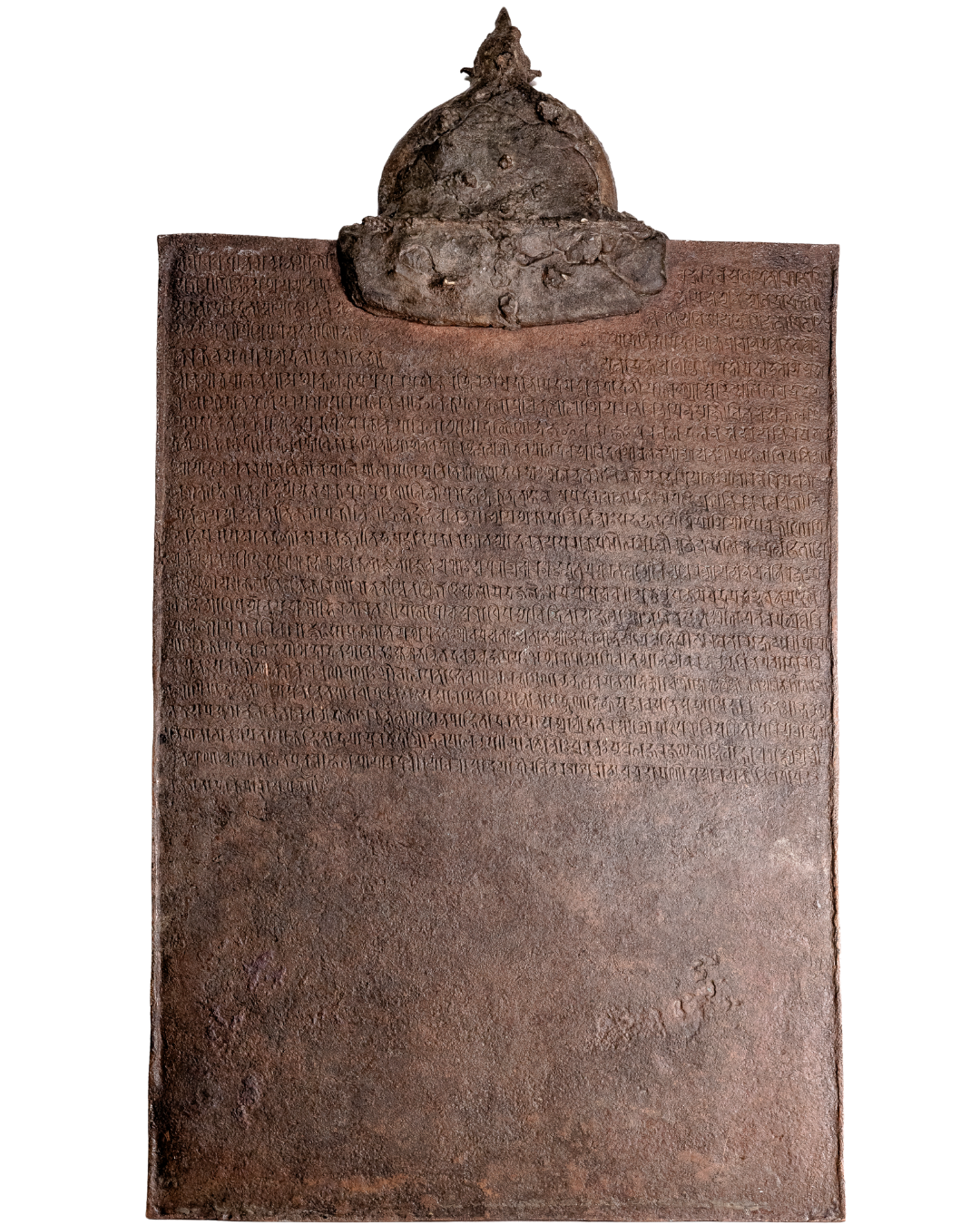
The copper plate was discovered at Nalanda in 1921, containing forty-two lines on the obverse and twenty-four on the reverse. The inscription is written in the early Devanagari script in the Sanskrit language. The inscription runs in prose and verse. The seal bears the name of the reigning Pala King, ‘Shri Devapaladevasya’ or ‘the illustrious Devapala’ is inscribed below the wheel of law (dharmachakra) motif. This symbolises Buddha’s act of unfolding the law and disseminating knowledge to the people. The back to back deer recalls the first sermon at Sarnath, where the wheel of law was set in motion by Buddha. The inscription celebrates the request of King Balaputradeva, the ruler of Suvarnadvipa, who made a generous donation through his ambassador, by granting five villages, four of which lay in the Rajagriha. The inscription exalts of bringing merit and fortune to the King’s parents, for worshipping Buddha, for paying respect to the monks, and for the upkeep of the monastery at Nalanda. The document ends with the date of the endowment, 21st day of Kartika of the (regnal) year 29.
Obverse – English Translation:
1. Om, hail! Of Siddhārtha, whose mind was firmly established in altruism, who practiced the true path,
2. whose attainment was supreme success; of that Blessed One, whose actions among the people
3. led to the attainment of the stage of perfection of beings in the three worlds; having conquered by exceedingly fierce energy,
4. he attained nirvāṇa. The Sugata, the lord of the ground of all aims.
5. Endowed with incomparable fortune, he became, together with Śrī (Lakṣmī), the lord of the earth like Gopāla.
6. When such an example exists, he became worthy of faith among the meritorious; even Pṛthu, Sagara and others became renowned thereby. Having conquered Vena, he liberated the earth from the ocean of futile grasping.
7. With tearful eyes, shedding tears, he again beheld his kinsmen amid herds of elephants.
8. Amid the ceaseless movements of whose forces the earth itself trembled under kings.
9. For whom even the sky became fit for the passage of footsteps, like the path of birds.
10. Understanding the meaning of the śāstras, he established the moving social orders in their own proper duties.
11. By his son Śrī Dharmapāla, the enemies of those ancestors dwelling in heaven were destroyed.
12. Harassed by moving and unmoving forces, by elephants wildly agitated,
13. the earth, dust-like, sought refuge in him without calamity.
14. At Kedāra, together with the Ganges, at Buddha (Bodhgayā), and also at Gokarṇa,
15. he duly performed righteous acts at holy bathing places.
16. For whom there was happiness for servants alone; who uprooted all the wicked and achieved the welfare of the people, whose fame was stainless and bright.
17. At the conclusion of each campaign of conquest, envoys sent by rival kings removed all distress by honoring him and returning to their own lands.
18. By suitable actions done with affection, the hearts of kings became eager for him, like recollections of a former birth.
19. He took the hand of Raṇṇādevī, daughter of Śrī Paravala, the ornament of the Rāṣṭrakūṭa kings, and became a householder.
20. Was she Lakṣmī herself embodied, or the earth made corporeal, or the very form of the king’s glory,
21. or the household deity?—thus reasoning, she, pure in conduct and discerning in thought,
22. raised the people, afflicted by natural faults, by means of noble inner virtues.
23. She was praiseworthy, a devoted wife, like a pearl freed from the ocean-shell.
24. To Śrī Devapāla-deva was born a son with a pleasing countenance.
25. Pure in mind and speech, restrained and steadfast in action, established in purity,
26. he obtained the kingdom without disturbance, like a Bodhisattva attaining the Buddhist state.
27. Advancing irresistibly in the course of conquest with elephants, he traversed the Vindhya forest like a swelling flood; once again his kinsmen were seen.
28. In Kamboja lands, by youthful horsemen, the strength of other kings was shattered; mingled with the cries of horses and trumpeting elephants, long-sustained were the sounds of battle.
29. He who earlier was overcome by Bali in the Kṛta age; by Bhārgava in the Tretā age; slain by Karṇa in the Dvāpara age;
30. severed by Kali, the enemy of the Śakas, in the Kali age—by him the path of renunciation was once again clearly revealed.
31. From the coming of the Ganges, from the famed banner of Daśāsya (Rāvaṇa) to the bridge, and from Varuṇa’s abode to the Sindhu,
32. and to the mansion of the lineage of Lakṣmī—he enjoyed the entire earth.
33. Indeed, while the path of the Bhāgīrathī flowed, enriched with many boats, bridges, embankments, quarries and mountain ridges,
34. darkened by dense masses of rain clouds, shining with vast prosperity, crowded with countless kings offering tribute,
35. dust raised by innumerable horses and mules, the earth bent under the burden of kings of Jambudvīpa who came to serve the Supreme Lord.
36. Meditating on the feet of Śrī Dharmapāla-deva, the Supreme Buddhist, Supreme Lord, Supreme Sovereign,
37. the illustrious Mahārājādhirāja Śrī Devapāla-deva issued this grant while in good health.
38. In the district of Rājagṛha, within Śrī Nagarabhukti, comprising Ajapura and its dependencies, with uninterrupted boundaries, including the villages—
39. Nandivānaka, Maṇivāṭaka, Naṭikā, Hastigrāma, and others in Gayā district,
40. together with all officials—royal nobles, princes, ministers, generals, guards, provincial officers, tax collectors, police, soldiers, elephant, horse and boat officers,
41. Brahmins and residents living by the king’s feet are informed that the land grant should be protected, knowing the merit of donation and the great hell that follows confiscation.
42. Taxes and revenues should be paid as prescribed. Year 39, on the 21st day of Kārttika.
Reverse – English Translation:
43. And thus the verses declared in the law-books are cited—land was given by former kings,
44. such as Sagara and others: “Whosever land it is, to him belongs the fruit thereof.”
45. Whoever seizes land given by himself or by another,
46. he is cooked in hell along with his ancestors, becoming a worm in excrement.
47. The giver of land rejoices in heaven for sixty thousand years; the confiscator or approver thereof,
48. dwells in hell for the same period. Protect with care land given to twice-born, O Yudhiṣṭhira.
49. The protection of land is superior even to the gift itself among kings.
50. This gift, upheld by our noble lineage and others, should be approved; for the gift, though unstable like lightning and water,
51. preserves supreme fame in the hereafter.
52. Reflecting that human life is fleeting like a drop of water on a lotus leaf,
53. and understanding this teaching, wise men do not destroy the fame of others.
54. Like the king’s right arm, independent and aiding in crushing enemy forces,
55. Śrī Balavarman performed the duty of envoy in this religious undertaking.
56. In this commencement of the religious act, he served as envoy of Śrī Devapāla-deva,
57. Śrī Balavarman, lord of the Vyāghrātati region.
58. There was the king of Yava land, whose lotus feet were illumined by the brilliance of the crowns of all kings,
59. the ornament of the Śailendra dynasty, named Śrī Vīra-Vairimathana.
60. His fame, as if embodied, moved through palaces, lotuses, stalks, conches, moons, jasmines and snow,
61. being sung endlessly in all directions throughout the worlds.
62. From the bending of his brows alone, the prosperity of enemies, together with their hearts, was destroyed;
63. indeed, those skilled in harming others meet dreadful fates in the world.
64. He had a son, endowed with policy, valor and virtue, whose feet were illumined by hundreds of royal crowns.
65. As long as the ocean remains bounded, the Ganges flows, mountains stand, and the sun rises and sets,
66. so long may this noble fame endure, establishing righteous conduct in the world.