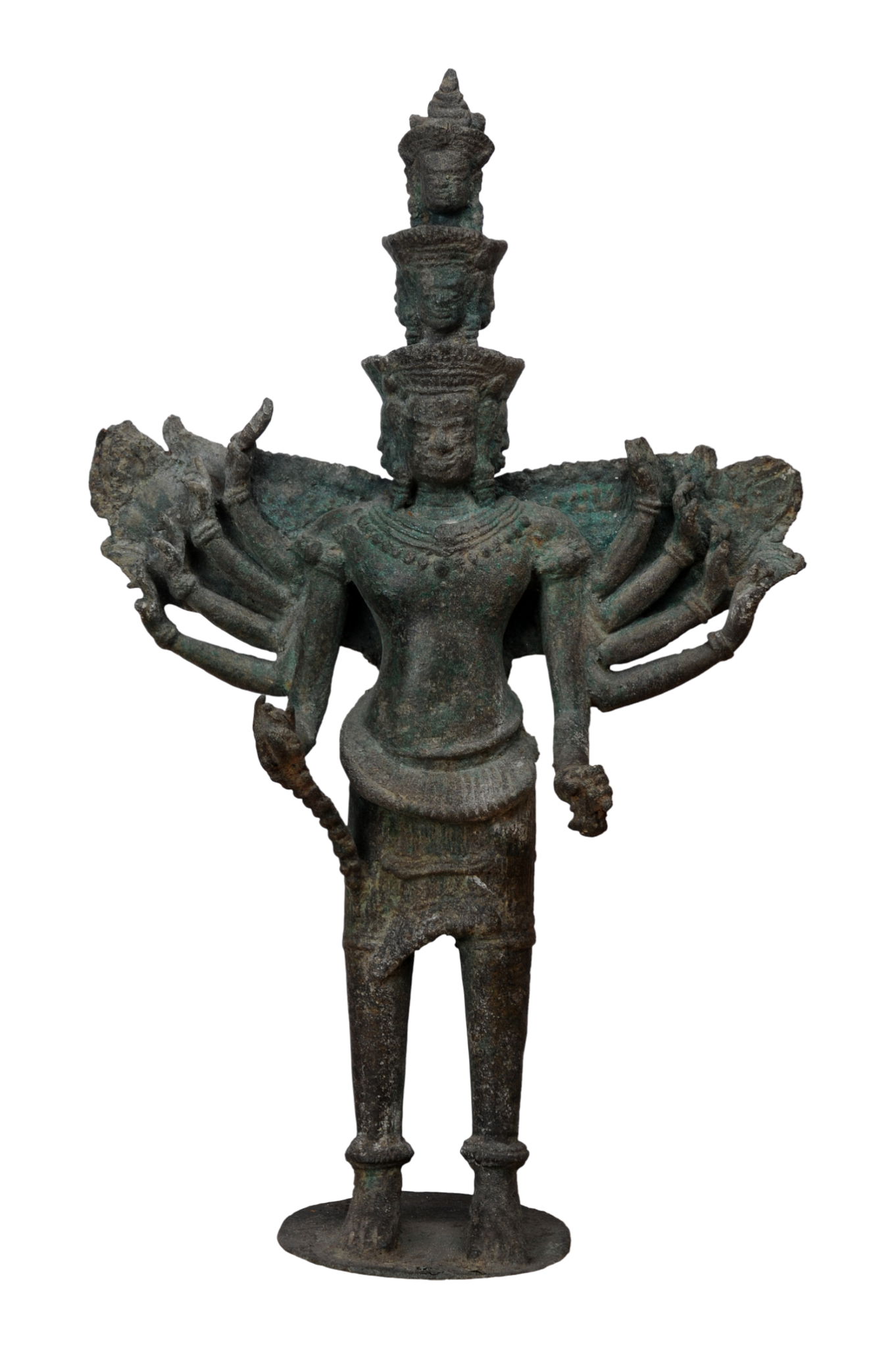
In Southeast Asian art, Avalokiteshvara is widely represented as Lokeshvara, a tradition that took root in the Pala period in India. In Khmer art, Lokeshvara’s iconography follows a similar representation as seen in the Pala idiom. In his regal depiction, Lokeshvara is also referred to as the protector of the world (lokeshvararaja), a title also taken by the Khmer Buddhist king, Jayavarman VII. The bronze figurine of Lokeshvara is similar in physiognomy and is stylistically attributed to the Khmer sculptures of 12th century CE. Lokeshvara’s ten arms bear various attributes. Along with the multiple-arms, in Khmer art, we also see the eleven-headed (ekadaśamukha) variant. The stylistic features are highlighted with pointed conical crowns, large drooping earrings, a short lower garment (dhoti) with a folded sash around the waist. As mentioned in the Karandavyuha Sutra, each level of three heads indicates that the eleven-headed (ekadashashirsha) Lokeshvara is looking at three worlds, the world of desire (kamadhatu), the world of living forms (rupadhatu), and the world without form (arupadhatu); overlooked by Amitabha Buddha himself. This figurine is endowed with seven-heads in three tiers while looking back to the eleven-headed forms of Lokeshvara prominently seen in Khmer art. The Sadharmapundarika Sutra recalls Avalokiteshvara as facing all four directions (samantamukha) to help all beings. Further, the ten-stages (dashabhumis) associated with the attainment of perfections (paramitas) by a bodhisattva is also related to his tiered heads.