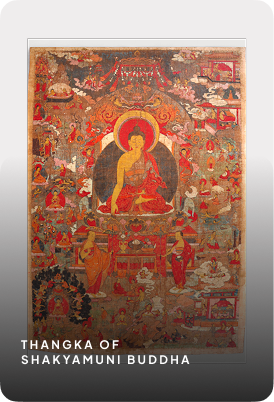
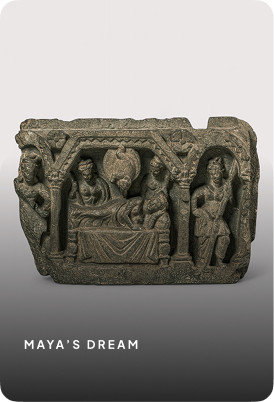
Another important event of in the life of Buddha is the descent from the heaven the thirty-three gods (Trāyastriṁśa), where he had gone to preach dharma to his mother for three months. This stele depicts Buddha in a frontal pose, his right hand in the boon-bestowing gesture (varada mudra). The Hindu deities, Brahma and Indra, are shown standing on the right and left, respectively. Brahma is four-faced and is adorned with a matted coiffure (jatamukuta) and holds a decorated parasol (chattravali). At the same time, Indra wears a jewelled crown (kiritamukuta) and offers an offering tor Buddha.
The inscription on the plaque reads as follows:
Read: (By Mukant Bishwas): ye dharmmā hetu-prabhavāḥ hetuṁ teṣāṁ tathāgato hyavadata teṣāṁ ca yo nirodha evaṁ-vādī mahāśramaṇaḥ.
Translation (literal): The Tathāgata has declared the causes of those phenomena which arise from a cause, and also their cessation. Thus speaks the Great Ascetic (Mahāśramaṇa).