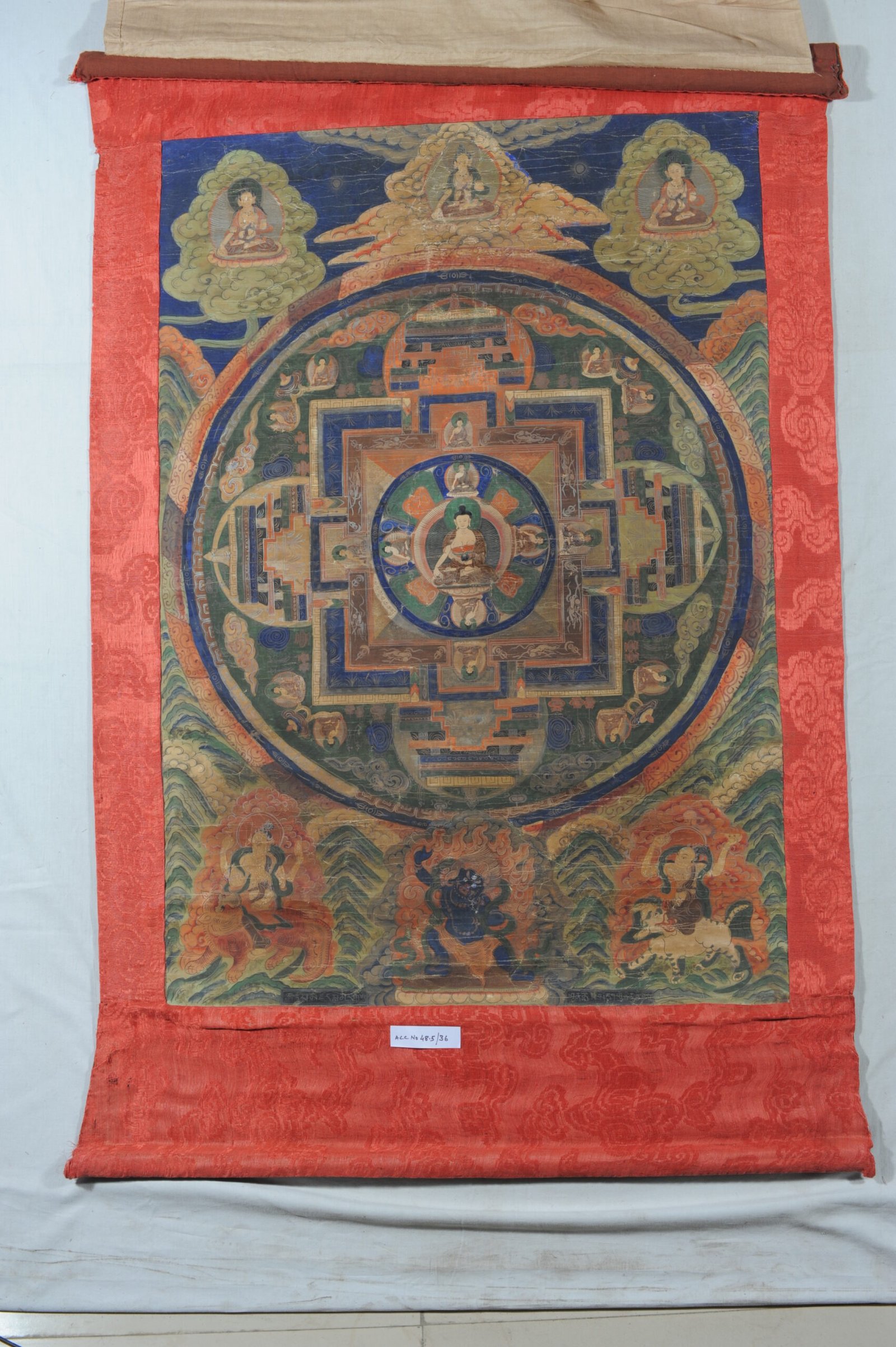
The thangka depicts the Bhaishajyaguru Buddha, also known as the Medicine Buddha. The forms and ritual practices associated with the Medicine Buddha are derived from the Bhaishajyaguru Sutra, which, according to Buddhist tradition, was taught by Shakyamuni Buddha. In the Vajrayana Buddhist tradition, this sutra is classified as part of Tantra literature and falls under the Kriya classification.
At the centre of the mandala is Medicine Buddha Bhaishajyaguru, who holds a bowl in his right hand resting on his lap. In contrast, his left hand is in varada mudra (a gesture of generosity). Surrounding him are four Buddha figures, each seated at the cardinal points. The circular area is enclosed within a square that features four entrances. The palace floor is divided into four colours: blue, yellow, red, and green, each guarded by Buddha images.
The square enclosure consists of five walls, each painted a different colour. The four doors are marked by ‘T’-shaped structures topped with four steps, two deer, and a Dharma wheel. Surrounding the outer space are pairs of Buddhas holding vases, all enveloped by clouds. In this painting, there is a clear demarcation between earth and sky, achieved through thoughtful artistic rendering and a carefully chosen colour scheme. Green dominates the composition, while blue is used symbolically.
At the top, three Bodhisattvas sit on lotus pedestals, surrounded by soft, cloud-like patterns. At the bottom, a captivating trio of Buddhist deities stands, each radiating wisdom and serenity. On the left, the golden-complexioned Manjushri (Jampel Yang), a bodhisattva, is depicted seated majestically on a lion, symbolising the strength and fearlessness of his wisdom in overcoming ignorance. He is shown making a preaching gesture with his hands; his left hand holds a manuscript of the Prajnaparamita Sutra on a lotus flower, symbolising transcendent wisdom. In his other hand, he has a rosary.
The central figure is Vajrapani, represented in a wrathful, two-armed form, in a warrior pose, surrounded by an effulgent halo. On the right is Vaishravana, the Buddhist God of Wealth and Guardian of the North, depicted riding a white snow lion. He is golden-yellow in colour and holds two skull cups in his hands, along with his usual attributes, which include a ‘banner of victory’ and a mongoose that spews jewels, symbolising generosity and fortune.
Many textual works within the Kriya classification are understood as both sutras and tantras simultaneously. The imagery and practices of the Medicine Buddha are familiar across all Tibetan and Himalayan Buddhism and are particularly significant in Tibetan medical schools and traditions..